
Our delightful gothic style church is dedicated to St. Peter and St. Paul and is the third built on the same consecrated site. (c 1250 – 1350) The Domesday Book of 1086 describes how the church in Barnby Dun was a simple structure comprising of a Chancel and a Nave built
on rubble and sea pebbles which the villagers ploughed up in the course of their work as farmers.
Towards the end of the 13th century, the Church was too small to satisfy the needs of the parishioners, so a larger building had to be constructed on the same piece of land.
The Nave was built first in order to erect the Arcades. (The columns and archways on the foundation of the original Nave walls) A professional mason was employed, as the work required a certain amount of stone carving.
Once the Arcades had been built, the walls were heightened to form the Clerestory, the purpose of which was to introduce more window space and light into the church. While the Mason was busy at his work, the villagers set about constructing the outer walls of the aisles
thereby enlarging the Nave sideways.
Much of the original stonework from the Nave walls were used when the inner part of the aisle walls was built. The outer section of the south wall was built of random rubble in layers and then finished off with stone blocks up to roof height.
The north wall, built after the south wall, was onstructed of more buttresses, some of which had hollow niches in which the statutes of saints were placed. (A buttress is an architectural structure built against or projecting from a wall which serves to support or reinforce the wall)
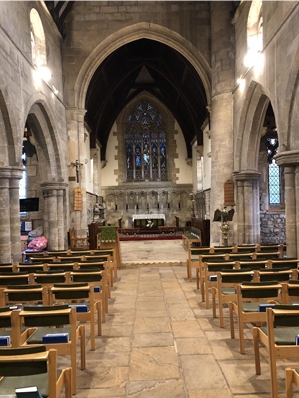
The Nave was built first in order to erect the Arcades.
The south porch, built later in the 14th century also acted as a buttress.
The Nave was joined to the Chancel by means of the Chancel Arch, the south pier of which contained the Rood Stair. This gave access to the Rood which passed over the archway.
The Nave was completed with the erection of a high-pitched tiled roof but this later created a major problem. The style of the roof and the inadequate foundations of the Arcade walls caused the upper parts of both Clerestory walls to move outwards, no doubt creating alarming cracks in the west wall and above the Chancel Arch.
To remedy this, in around 1450, the Tower was built to bond the walls together. At the same time, the original sloping roof was replaced by a flat leaded one.
Once the Nave was finished, in around 1345, the Patron took up the rebuilding of the Chancel. In those days, it was the custom for the parishioners to be responsible for the maintenance of the Nave whilst a patron attended to the Chancel. The Newmarche family held the patronage of the church until the middle of the 14th century.
Rev. Joseph Hunter (1783-1861) in his book “The history of the topography of the Deanery of Doncaster” tells us that in 1620, there was a window in the south side of the Chancel. The window was bordered with the arms of the Newmarche family.

We do not know what the Chancel looked like, but the work was not well done.
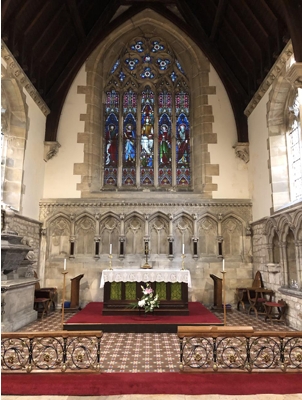
Between 1859 and 1862, the Chancel was completely rebuilt from the foundations up, in the Victorian gothic revival style. The floor was laid with tiles of variegated colours, choir stalls were installed and the pulpit and reading lectern installed. Some interesting features of the
old Chancel were retained: –
- The Piscina (a shallow basin near the altar of the church used for washing the communion vessels).
- The Triple Sedilla (a set of seats built in the South wall of a Church or Chancel for the officiating clergy).
- The Priest’s door.
- Some of the original hollow buttresses.
Since Hunter does not mention the figurehead brackets on the three light window and the decorated recess found at the east end of the north aisle, it is believed that this was once a Chantry Chapel within in the original Chancel area. (A Chantry Chapel was a designated area within a church, specifically set aside for the performance of liturgical services.)
The splendid east window above the Altar is in the gothic style.
From left to right is St. Paul, St. Peter, Jesus, St. John and St. James the Great.
While the chancel was being rebuilt during the last century, the Nave was also modernized with Victorian tiles and the flat leaded roof replaced so that both the Chancel and Nave roofs were built as one high pitched and slated roof.


In 1990, the Church was considerably renovated.
Much of the exterior stonework of the Nave remains as it was in the 14th century though much worn in parts, but one can still discern the grotesque gargoyles and figureheads of the window drip stones. The problem today is one of maintenance to overcome the effects of erosion. Maintaining an ancient building which is part of our English culture and heritage, is
a costly business.
There are a few additional interesting features within the Church : –
- The ancient Elizabethan chest from the 15th Century.
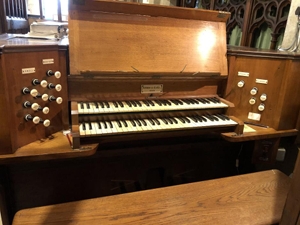
- The Pipe Organ which was installed in 1909 and is considered to be a fine example of the
work of Messrs Norman & Beard. - The Tower which contains a spiral staircase to the Belfry. In 1887, the year of Queen
Victoria’s Jubilee, the existing peal of ancient bells were re-ordered and increased in number
to six.
In 1990, the Church was considerably renovated. Worn stonework was replaced, the floor re-laid in stone, modern lighting installed, and comfortable seating introduced.
Improvements have continued over the years with the introduction of audio-visual equipment, a computer, electronic display screens and the potential for internet access.
The Church continues to have a distinctive and valued presence in the local community and across Doncaster.
